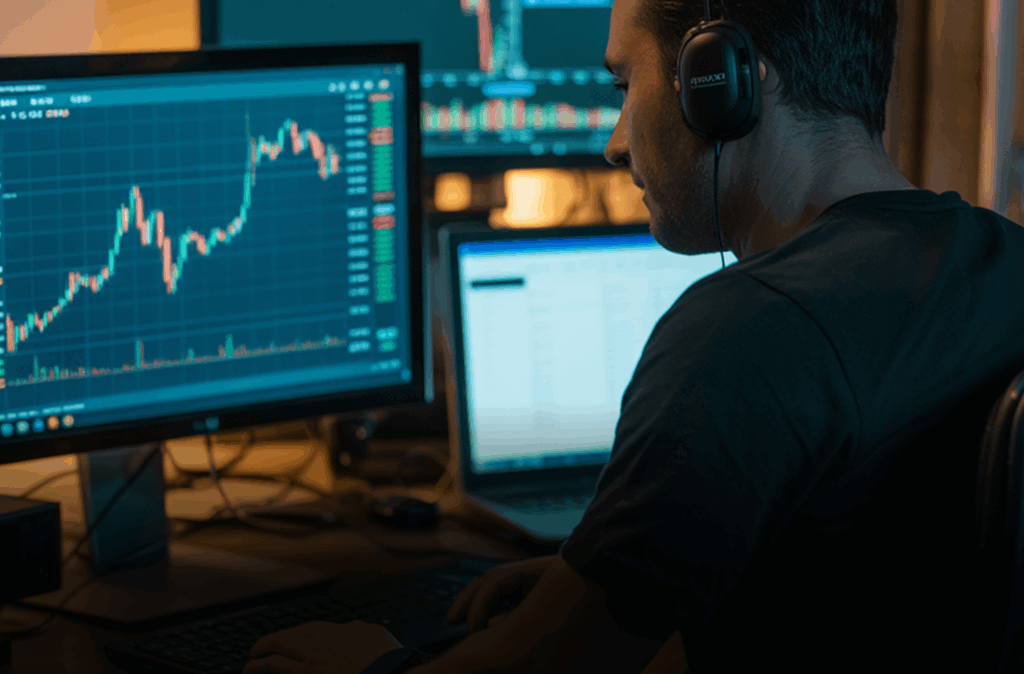
Every trader has experienced this frustrating pattern.
You start your morning session sharp and focused. The charts make sense. Your entries are clean. Your risk management is disciplined. You execute three solid trades and bank consistent profits.
Then afternoon arrives.
The same setups that worked beautifully in the morning suddenly feel different. You hesitate on entries you would have taken confidently hours earlier. You second-guess your stops. You exit winners too early out of anxiety. You take trades that don’t quite meet your criteria, justifying them in the moment.
By the closing bell, your morning gains have evaporated – or worse, turned into losses.
If this sounds familiar, you’re not alone. And more importantly, you’re not broken.
You’re experiencing one of the most underestimated forces in trading: decision fatigue.
The Hidden Enemy Destroying Your Trading Performance
Here’s what most trading education completely ignores: your brain has a finite amount of decision-making energy each day.
Every choice you make – from trivial decisions like what to have for breakfast to critical decisions like whether to enter a trade – depletes this mental resource. It’s not about willpower or discipline. It’s about cognitive capacity.
And by afternoon, your decision-making tank is running dangerously low.
This isn’t trading theory. It’s neuroscience backed by compelling real-world evidence.
Research on judges shows they’re more likely to grant parole in the morning than in the afternoon. When faced with identical cases, the same judge makes more lenient decisions early in the day and more conservative (denial) decisions later – not because the cases changed, but because their mental energy depleted.
Doctors make more errors later in their shifts. Strategic business decisions made in afternoon meetings are statistically more risk-averse than those made in morning sessions.
And traders? The pattern is even more pronounced.
Studies of professional traders show performance quality drops by 30-40% after the first three hours of active decision-making. Not because afternoon markets are inherently more difficult. Not because strategies stop working.
Because the brain responsible for discipline, logic, and impulse control has been working overtime – and it’s exhausted.
Decision Fatigue
Most traders think they’re only making decisions when they click “buy” or “sell.” This fundamental misunderstanding is precisely why decision fatigue catches them off guard.
In reality, your brain is processing and deciding on hundreds of variables throughout your trading session:
Chart Analysis Decisions:
- Which timeframe should I prioritise right now?
- Is this pattern significant or just noise?
- Should I wait for more confirmation or is this enough?
- Is this pullback adequate or should I wait for deeper retracement?
Risk Management Decisions:
- Where exactly should my stop loss go?
- Should I move my stop to breakeven now or wait?
- Is this position size appropriate given current volatility?
- Should I scale out partially or hold for full target?
Trade Management Decisions:
- Should I add to this winning position?
- Is this profit sufficient or should I let it run?
- Do I trust this setup or does something feel off?
- Should I take this trade or wait for the next one?
Market Monitoring Decisions:
- Is this news event significant enough to affect my trades?
- Should I close positions before this announcement?
- Is this price action normal volatility or the start of a reversal?
- Do I have time for another trade today?
Each of these micro-decisions seems insignificant in isolation. But by 2pm, you’ve made thousands of them.
Your prefrontal cortex – the part of your brain responsible for rational decision-making, impulse control, and discipline – is depleted. It’s functioning at a fraction of its morning capacity.
This is precisely when the destructive patterns emerge:
- Revenge trading after a loss
- Ignoring your predetermined rules
- Taking trades that “sort of” meet your criteria
- Overtrading because you feel you should be doing something
- Exiting positions based on anxiety rather than analysis
- Moving stops impulsively instead of systematically
These aren’t character flaws. They’re predictable symptoms of cognitive fatigue.
Why Afternoon Trading Feels Different (Because It Is)
Understanding the mechanism behind decision fatigue explains why afternoon trading feels fundamentally different from morning trading – even when you’re looking at identical setups.
Morning Brain: Full Cognitive Capacity
When you’re mentally fresh, your brain can:
- Evaluate multiple variables simultaneously
- Maintain emotional detachment from individual trades
- Follow your predetermined rules without internal negotiation
- Distinguish clearly between high-probability and marginal setups
- Manage risk rationally based on system parameters
Your morning trades succeed not because morning markets are easier, but because you’re operating at peak cognitive performance.
Afternoon Brain: Depleted Cognitive Resources
After hours of continuous decision-making, your brain shifts into a different mode:
- Complex analysis becomes mentally taxing, so you oversimplify
- Emotional regulation weakens, making you more reactive
- Rule-following requires active effort rather than flowing naturally
- Marginal setups look more attractive because evaluation is harder
- Risk management feels negotiable because discipline is exhausting
The market hasn’t changed. The setups are similar. But your mental operating system is running on reserve power.
This explains the frustrating pattern nearly every trader experiences: You know what you should do, but somehow you can’t execute it with the same consistency you had earlier.
It’s not a motivation problem. It’s a biology problem.
The Decision Fatigue Danger Zone: When Most Accounts Blow Up
Here’s the particularly insidious aspect of decision fatigue: it doesn’t announce itself.
You don’t suddenly feel incompetent or incapable. In fact, decision fatigue often creates false confidence because fatigued brains seek shortcuts and certainty to reduce the burden of complex analysis.
This is when traders:
Take impulsive trades because “it just feels right” (your brain wants to reduce analysis burden)
Ignore stop losses because “it’s definitely coming back” (your brain craves certainty over probability)
Revenge trade because “I need to make it back” (depleted impulse control can’t override emotional reactions)
Overtrade because “I’m here anyway, might as well find something” (fatigued brains struggle with doing nothing)
Break position sizing rules because “this one is different” (decision-fatigued brains rationalise rule violations easily)
The tragic irony? Most traders identify these as discipline problems and try to solve them with more willpower.
But willpower is precisely what’s depleted. You’re trying to fix a resource problem with the resource that’s already exhausted.
How Elite Traders Protect Their Decision-Making Energy
The consistently profitable traders aren’t superhuman. They haven’t mastered some secret meditation technique that gives them unlimited mental stamina.
They’ve simply learned to treat mental energy as the finite, precious resource it actually is.
1. They Trade in Focused Blocks, Not Marathon Sessions
Amateur traders: “I’ll watch the markets all day to catch every opportunity.”
Professional traders: “I’ll trade my highest-probability window with complete focus, then step away.”
The difference is profound.
Elite traders identify when their best setups typically occur – whether that’s the London open, the first two hours of the New York session, or specific times when their preferred pairs show the most reliable behaviour.
They bring their full cognitive capacity to these focused periods. Then they close their platform.
This isn’t about trading less. It’s about trading at your best.
2. They Reduce Unnecessary Decisions Ruthlessly
Every decision you don’t have to make preserves energy for decisions that actually matter.
Professional traders build systems that eliminate cognitive burden:
Pre-defined entry criteria (no debate about whether a setup qualifies)
Automated alerts (no need to constantly scan for opportunities)
Checklists (removes the burden of remembering every condition)
Fixed position sizing formulas (eliminates real-time risk calculations)
Predetermined stop loss and take profit levels (no in-trade negotiation)
Trading session time limits (removes the decision of when to stop)
These aren’t crutches for beginners. They’re efficiency tools that preserve mental energy for the aspects of trading that genuinely require judgment and discretion.
3. They Know Their Personal Performance Patterns
Through consistent journalling, elite traders develop intimate knowledge of their own performance patterns.
Some discover their edge disappears after 1pm. Others notice quality degradation after four consecutive trades, regardless of time. Some identify that trading during their children’s school pickup time creates anxiety that bleeds into decision-making.
The specific patterns don’t matter. The self-awareness does.
When you know your own cognitive rhythms, you can design your trading schedule around reality rather than forcing yourself to function at times when you’re statistically likely to underperform.
This isn’t making excuses. It’s strategic optimisation.
4. They Understand That Discipline Isn’t Infinite
Perhaps most importantly, consistently profitable traders have abandoned the myth of unlimited willpower.
They don’t try to trade through decision fatigue. They don’t push themselves to “just be more disciplined.” They don’t treat cognitive exhaustion as a character flaw to overcome.
They recognise it as a biological reality to design around.
The trader who takes five high-quality trades during peak mental hours will dramatically outperform the trader who takes fifteen trades spread across a full day-even if the latter trader’s strategy has a slight edge.
Because edge doesn’t exist in a vacuum. It exists in execution. And execution quality is directly tied to cognitive capacity.
The Psychological Framework That Changes Everything
Understanding decision fatigue transforms how you approach trading at a fundamental level.
Old mindset: “I need to be more disciplined and follow my rules consistently throughout the entire day.”
New mindset: “I need to protect my decision-making energy and deploy it strategically during windows when I operate at peak performance.”
Old approach: Trading from 7am to 5pm because “more screen time equals more opportunities.”
New approach: Trading from 8am to 11am with complete focus, then using afternoon hours for review, education, and preparation-activities that don’t require real-time high-stakes decisions.
Old solution: “I’ll try harder to stick to my rules in the afternoon.”
New solution: “I’ll restructure my trading schedule to align with my cognitive capacity, not fight against it.”
This shift isn’t semantic. It’s fundamental.
One approach blames you for being weak. The other empowers you to design around reality.
How Proper Capital Amplifies Your Cognitive Advantage
Here’s where the psychological dynamics of funded trading create an often-overlooked advantage.
When you’re trading your own limited capital-especially if it’s savings you can’t afford to lose-every single decision carries enormous emotional weight.
You NEED this trade to work. You NEED to recover that loss. You NEED to hit your profit target this week.
This desperation burns through decision-making energy at double speed. The psychological burden of every micro-decision multiplies because the stakes feel existential.
Each decision costs you more mental energy when it’s wrapped in anxiety and desperation.
With proper funding, the psychological framework transforms:
You’re executing your edge over a large sample size, not trying to force perfection from every setup. Each individual trade matters less because you have the capital to trade your system properly across hundreds of executions.
Risk management becomes about statistics, not survival.
This psychological freedom preserves your mental energy for what actually matters: quality execution.
You’re still making the same trading decisions. But each decision costs less cognitive energy because it’s not bundled with existential financial anxiety.
The result? Your decision-making energy lasts longer. Your afternoon performance degradation is less severe. Your cognitive capacity extends further into your trading session.
This is why properly funded traders often report that their biggest psychological shift isn’t about the money-it’s about the mental clarity that comes from trading without desperation.
Practical Steps to Combat Decision Fatigue Starting Tomorrow
Understanding decision fatigue is valuable. Implementing systems that protect against it is transformative.
Step 1: Track Your Performance by Time of Day
For the next two weeks, journal not just your trades but the time you took them. Calculate your win rate, average R-multiple, and rule-adherence by hour.
You’ll likely discover clear patterns:
- Specific times when your win rate is highest
- Times when you take your worst trades
- Periods when rule violations cluster
This data removes guesswork. You’re not guessing when to trade. You’re identifying when YOU trade best.
Step 2: Define Your “Power Hours”
Based on your performance data, identify your 2-4 hour window of peak performance. This becomes your primary trading time.
For many traders, this is the first few hours after major market opens. For others, it might be a specific session overlap. For swing traders, it might be the first hour after work before dinner.
Your power hours are when you bring full cognitive capacity to trading.
Protect this time ruthlessly. No multitasking. No distractions. Complete focus on high-quality execution.
Step 3: Build Your Decision-Reduction System
List every decision your current trading process requires. Then systematically eliminate, automate, or predefine as many as possible:
Eliminate: Do you really need to check five timeframes? Can you simplify to two?
Automate: Set alerts for your entry criteria rather than constantly scanning
Predefine: Calculate position sizes in advance based on fixed risk percentages
The goal isn’t to remove all judgment from trading. It’s to preserve your judgment capacity for decisions that genuinely require it.
Step 4: Create a Hard Stop Time
Choose a time after which you will not take new trades, regardless of what appears on your charts.
This isn’t admitting defeat. It’s acknowledging reality.
Your afternoon self is statistically more likely to make worse decisions than your morning self. Having a hard stop protects you from your own cognitive depletion.
Many successful traders set their stop time at 3-4 hours after their trading session begins. Experiment to find your optimal window.
Step 5: Redesign Your Afternoon Activities
If you’re not trading in the afternoon, what should you do with that time?
Activities that don’t require real-time high-stakes decisions:
- Review and journal completed trades
- Backtest strategy adjustments with historical data
- Education and skill development
- Market analysis and preparation for tomorrow
- Physical exercise and mental reset
- Community engagement and learning from other traders
These activities support your trading without depleting the decision-making energy you’ll need tomorrow morning.
The Compound Effect of Managing Mental Energy
Here’s what happens when you restructure your trading around cognitive capacity rather than fighting against it:
Week 1: You notice you’re less exhausted after trading sessions. The anxiety and frustration decrease.
Month 1: Your performance consistency improves. Fewer catastrophic afternoon losses. More steady progress.
Month 3: Your win rate stabilises at a higher baseline. Rule violations become rare exceptions rather than frequent occurrences.
Month 6: You’ve developed a sustainable trading rhythm that feels natural rather than forced. Trading becomes something you do at your best, not something you struggle through.
Year 1: The compound effect of consistent, high-quality execution in focused windows dramatically outpaces the results of longer, lower-quality trading sessions.
This isn’t about trading less. It’s about trading better.
The Trading Career You Build vs. The Trading Career You Survive
There are two paths in trading:
Path 1: The Endurance Test
Trade all day, every day. Push through exhaustion. Blame yourself when afternoon losses erase morning gains. Try to willpower your way through decision fatigue. Treat cognitive limitations as personal failures. Burn out repeatedly.
Path 2: The Strategic Design
Identify your cognitive rhythms. Structure your trading around peak performance windows. Build systems that preserve mental energy. Treat your brain as the finite resource it is. Create a sustainable approach that compounds over years.
One path treats trading as a test of endurance and character. The other treats it as a professional skill requiring proper resource management.
Elite traders choose Path 2.
Not because they’re smarter or more disciplined, but because they understand that sustainable performance comes from working with your biology, not against it.
Your Next Step
Tomorrow morning, before you take your first trade, ask yourself one question:
“How many quality decisions do I have in me today?”
Then structure your entire trading day around that reality, not your wishful thinking.
Don’t open your platform expecting to trade for eight hours. Don’t assume willpower will carry you through cognitive fatigue. Don’t treat afternoon losses as character flaws.
Instead, bring your complete focus to your power hours. Execute with the full capacity of a fresh mind. Then step away before decision fatigue turns your morning gains into afternoon regrets.
The most successful traders don’t trade more hours. They trade their best hours with their best mental energy.
There’s a profound difference between screen time and productive trading time.
Your afternoon trades don’t have to sabotage your morning profits. But fixing this pattern requires more than awareness – it requires redesigning your entire approach around the reality of human cognitive capacity.
The question isn’t whether you experience decision fatigue. You do. Every trader does.
The question is whether you’ll continue fighting against it, or start designing around it.
Ready to trade with the psychological freedom that proper capital provides? Right now, we’re offering 50% OFF all evaluations plus a free account on pass to support your trading journey. Use code QTCARDS to access professional capital and build the sustainable trading framework that compounds success over time.
Decision fatigue affects every trader, regardless of experience level. The difference between those who succeed long-term and those who burn out isn’t talent – it’s sustainable system design that protects cognitive resources.